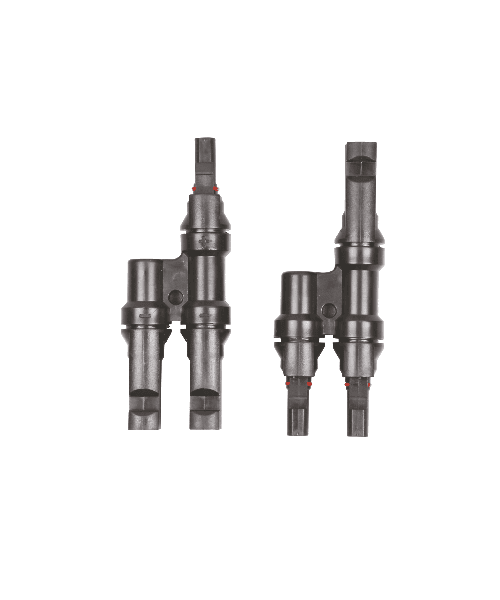
Branch Connector 1 to 3 for Parallel PV Connections
Branch connector 1 to 3 enables efficient parallel connections for expanding solar power systems and PV installations.
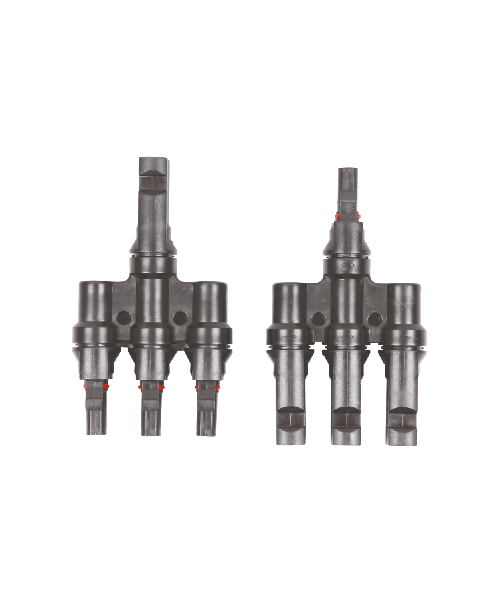
The Branch Connector 1 to 3 is designed to split one PV input into three parallel outputs, allowing flexible expansion of solar arrays. It ensures stable power transmission and balanced current distribution while maintaining a compact and practical design. This connector is ideal for optimizing system layout and simplifying wiring in various solar power applications.
SOLAR T BRANCH CONNECTOR SYSTEM
Technical Data(1 to 3)
Item | Specification | Item | Specification |
|---|---|---|---|
Connector system | MC4 CONNECTING | Insulation material | PPO |
Rated current | Certified by 50A | Locking system plug | Snap-in (nur/only MC4) |
Rated voltage | 1500V DC (IEC) / 600V DC (UL) | Flame class | UL94-HB / UL94-V0 |
Ambient temperature range | -40°C...+90°C (IEC) / -40°C...+40°C (UL) | Safety class | II |
Degree of protection, mated | IP67 | Contact system | MC Multilam |
Contact resistance of plug connectors | 0.5mΩ | Type of termination Crimpen | Crimping |
Contact material | Copper, tin plated | Cable Size | 2.5mm², 4mm², 6mm² |
Insertion Force /With Draw Force | <50N/>50N | Warranty | 5 years |
FAQs
Q1: What is a Branch Connector 1 to 3 used for?
It splits one PV input into three parallel outputs.
Q2: When should a 1 to 3 branch connector be used?
It is used when expanding or optimizing PV arrays.
Q3: Does it support balanced power distribution?
Yes, it is designed for stable parallel connections.
Q4: Is it suitable for large solar projects?
It is commonly used in commercial and utility systems.
Q5: Does it improve installation efficiency?
Yes, it simplifies wiring and system expansion.